Vendor Compliance Disputes Tool: Supplier chargeback workflow for time-limited dispute resolution
UX Designer · Sole designer and researcher, working with a PM and Engineering · 6-month project
Helping Home Depot suppliers recover revenue before dispute deadlines close.
Home Depot's vendor compliance program automatically assesses chargebacks for shortages, routing violations, pricing discrepancies, and labeling errors. Dispute windows are fixed and non-negotiable: miss the deadline and the deduction stands. As the sole designer and researcher working with a PM and Engineering, I led discovery, designed the workflow, and delivered a supplier-facing dispute tool that made each required decision and document visible before the window closed.
I interviewed suppliers managing active disputes and reviewed rejected dispute packages to understand where submissions were falling short. That research shaped the workflow sequence and every documentation requirement surfaced in the design.
A step-by-step dispute flow that matched the supplier's decision sequence.
From violation review through evidence submission, dispute reasoning, document upload, and activity tracking, each screen designed around one decision moment.
Shortages, pricing discrepancies, and routing violations, each with distinct documentation requirements and rejection criteria.
Home Depot only processes disputes above $25. Surfaced clearly to avoid wasted effort on auto-rejected submissions.
Submissions past the dispute window are not reviewed, the deduction stands. Time-awareness was a core design requirement, not a feature.
Comments, uploads, status, and activity history gave suppliers and Home Depot teams a single source of truth for every dispute.
The dispute window does not wait. The system had to make each step clear, documented, and easy to complete because a missed deadline was a financial consequence, not just a usability issue.
A time-sensitive process with clear review rules.
The research clarified what the product needed to do: help suppliers build a review-ready submission before the dispute window closed. The 90-day limit created real financial urgency, and every workflow step had to support timely, complete action.
Home Depot's Supplier Expectation Rating (SER) program automatically assesses chargebacks for fill rate misses, unauthorized carriers, labeling errors, and missing EDI ASNs. Suppliers could dispute those charges, but the process required timely action and evidence aligned with specific review criteria. The workflow needed to make those requirements clear before suppliers submitted, not after a package was rejected.
I interviewed suppliers and reviewed rejected dispute packages to understand where the process was breaking down. Reviewing those packages revealed a consistent pattern: suppliers were submitting valid disputes with missing or mismatched documentation, resulting in automatic rejections they could have avoided. That research showed what the workflow needed to surface at each step.
Compliance constraints
Violation types
SER violations (fill rate or on-time delivery failures), routing violations (unauthorized carriers or missing EDI ASNs), and labeling errors (pallet configuration, missing physical labels, packaging failures).
Required documentation by type
Shortage disputes: signed Proof of Delivery plus Bill of Lading plus carton counts. Routing disputes: carrier authorization evidence. Pricing disputes: invoice and pricing agreement. Missing any required document triggers automatic rejection.
A valid dispute rejected for missing documentation is the same outcome as an invalid one. The workflow had to surface exactly what each dispute type required, at the moment the supplier needed to provide it, so complete submissions became the default rather than the exception.
The research reframed the product from a submission form into a guided supplier action path. The goal was to help suppliers submit the right information, in the right sequence, before the window closed.
Each screen supported one clear decision moment.
The workflow was organized around the supplier's decision sequence — with each screen handling one specific moment: find what needs attention, understand the violation, choose the reason, provide evidence, and track resolution.
Suppliers had to understand the violation type, the correct dispute reason, the required documentation, and the next step — all at once. Without a clear sequence, suppliers could submit incomplete packages and lose the chance to recover valid charges.
Supplier interviews confirmed a clear decision sequence: find the violation, understand what it requires, confirm available documentation, select the dispute reason, submit evidence, communicate if needed, track status. The workflow followed that sequence exactly: inbox, violation detail, summary, dispute reason, document upload, comments, activity log. Working with the Supply Chain team, I mapped how Home Depot reviewers evaluated submissions, then designed each step to surface the information both sides needed at that moment.
Decision-sequenced workflow
Inbox as triage
Violations surfaced in deadline order, most urgent first. Threshold check visible before entering the submission flow.
Structured dispute reasons
Categorized selections aligned with Home Depot's review criteria, reducing rejection risk from reasoning mismatches.
Documents at point of requirement
Upload embedded in the flow where each document was needed, not deferred to a separate step.
Full audit trail
Every action timestamped: submission, status change, document upload, AP team response. Replaced back-channel email with structured, dispute-attached threads. Suppliers could track resolution without contacting Home Depot directly.
Breaking the process into decision moments reduced cognitive load and made the workflow easier to follow. It also made the review process more consistent because the right evidence was tied to the right dispute reason.
One continuous workflow from triage to resolution.
The design connected dispute triage, detail review, document upload, comments, and activity history into one continuous workflow — with violation context visible throughout and required information surfaced before submission.
I designed the workflow as a continuous sequence instead of separate pages. Each screen carried forward the violation details, submission status, and next available action — so suppliers never had to reconstruct the case context to complete the next step.
Triage and violation detail
Inbox & Violation Detail
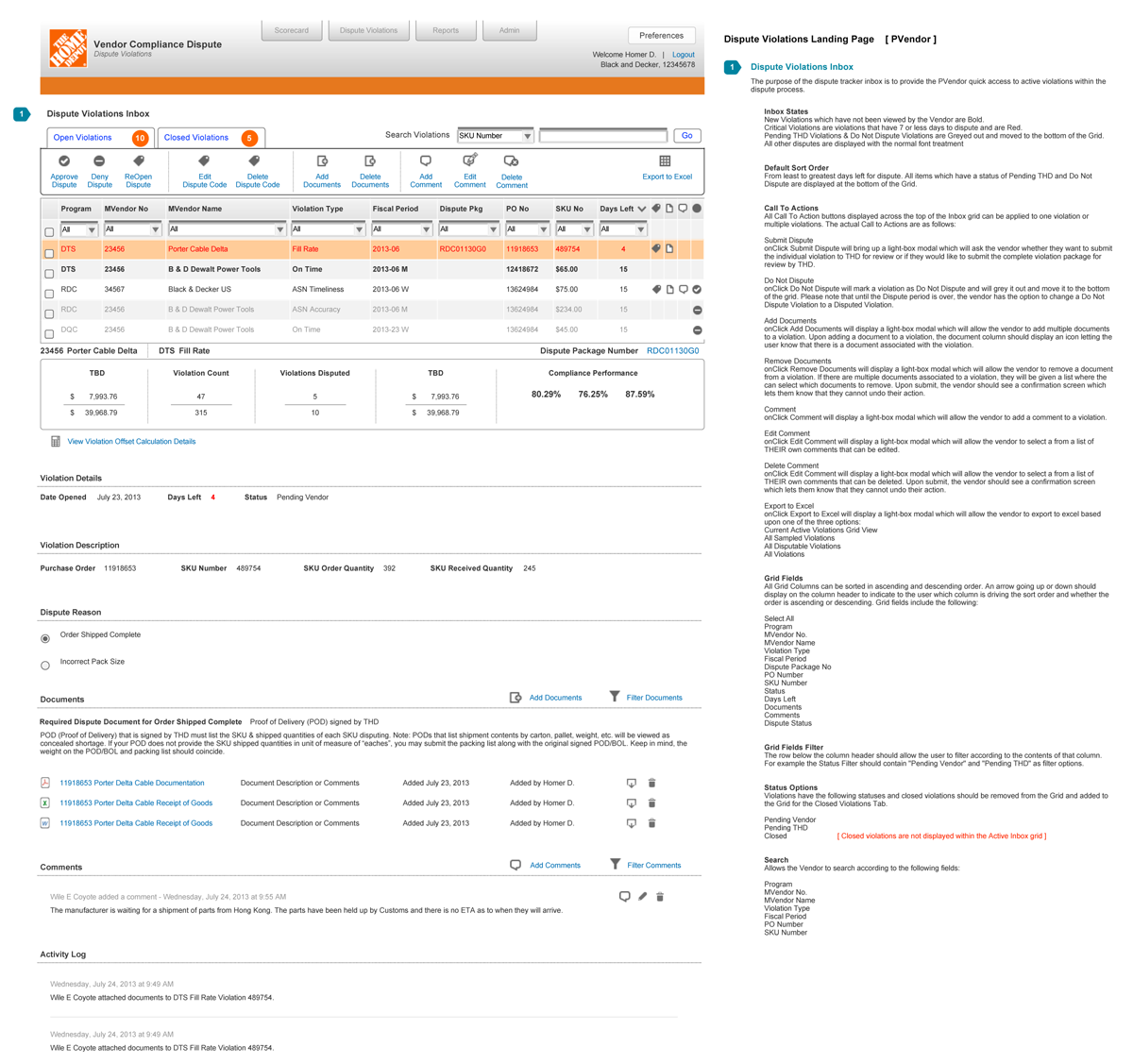
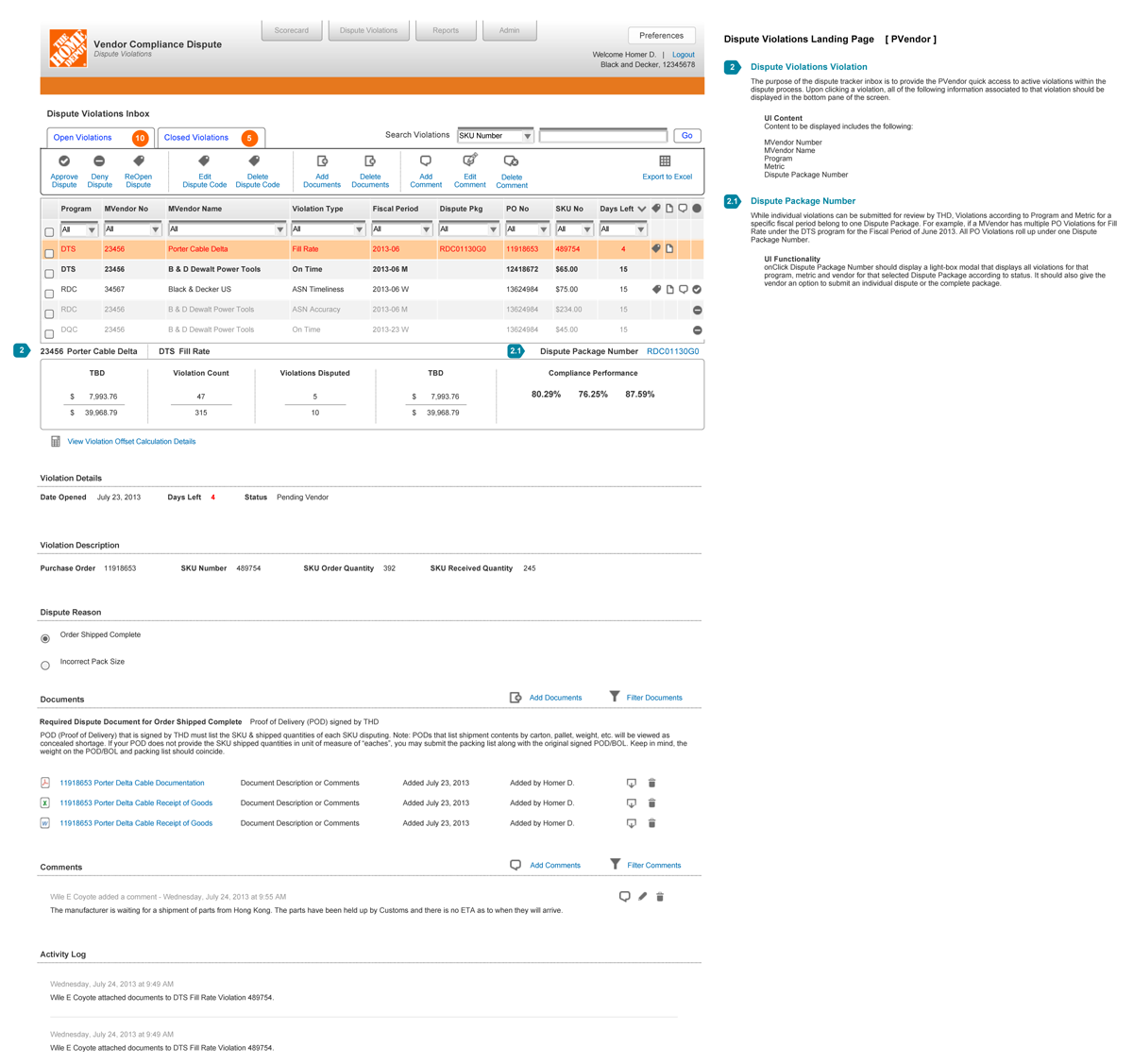
Inbox sorted by deadline urgency. Violation detail showed type, amount, required documentation, and threshold check before suppliers committed to the dispute flow.
Reason and evidence capture
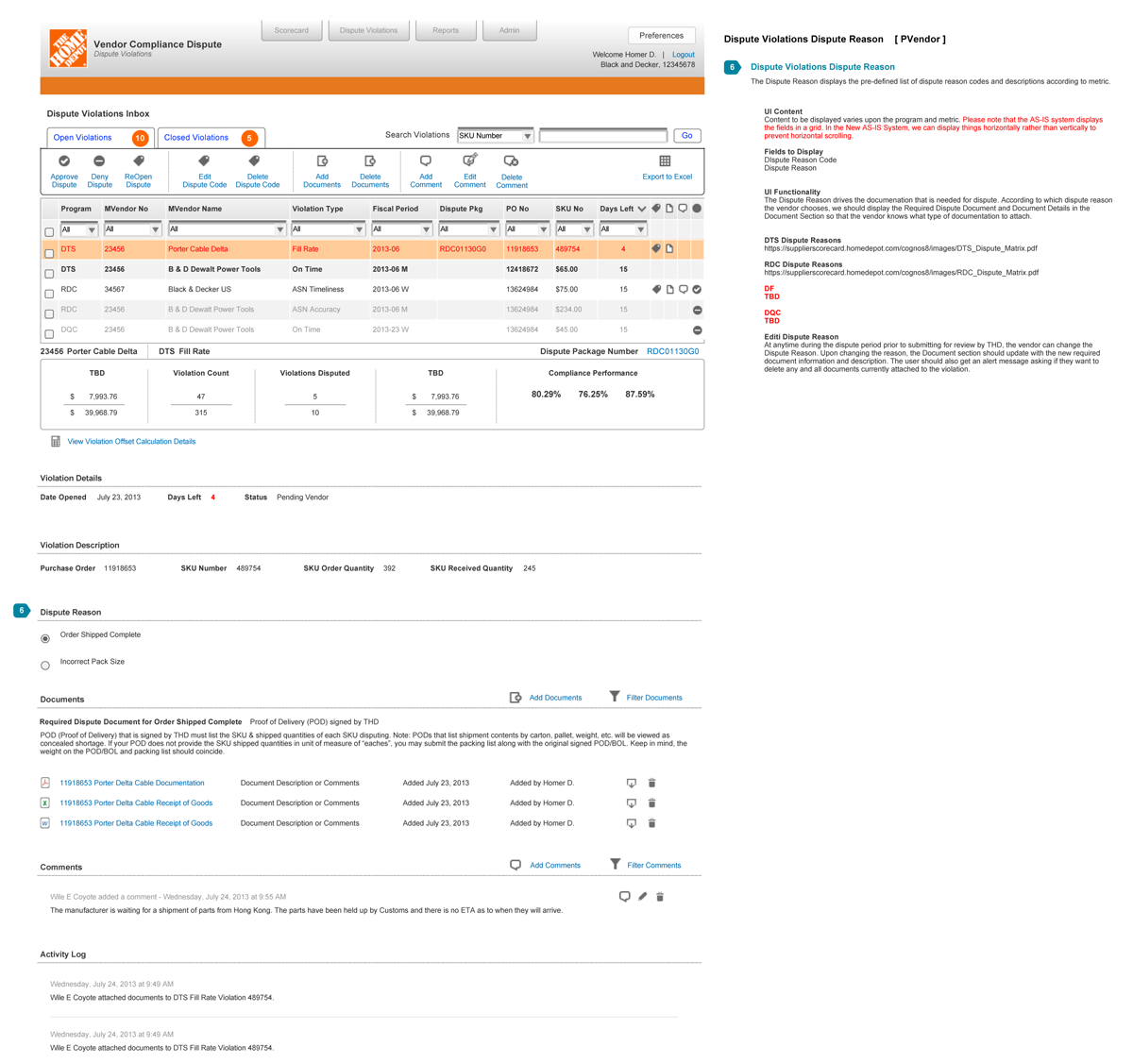
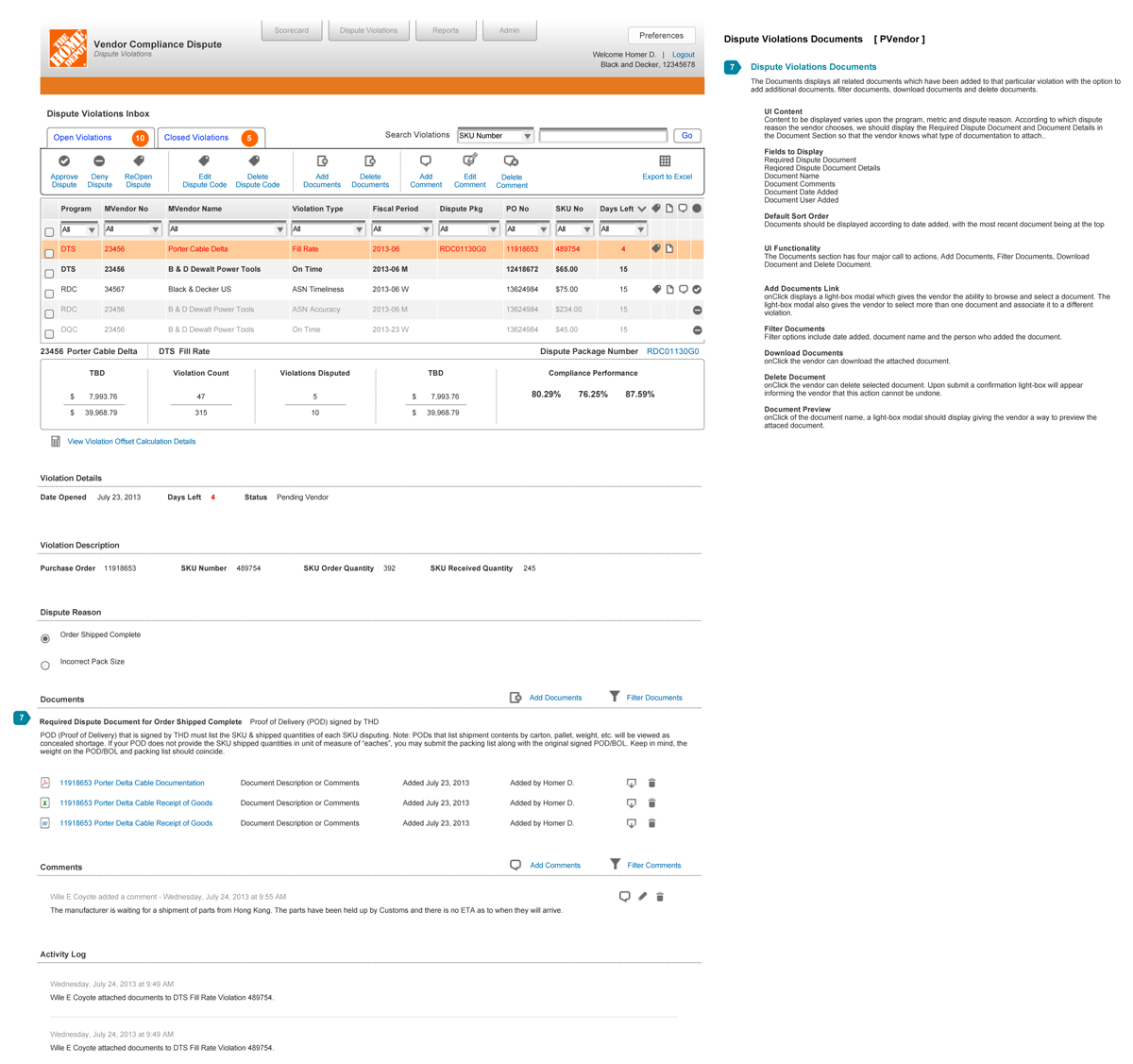
Dispute reasons as structured categories matched to Home Depot's review criteria. Document upload with required/uploaded status tracked, submission blocked until complete.
Shared audit trail
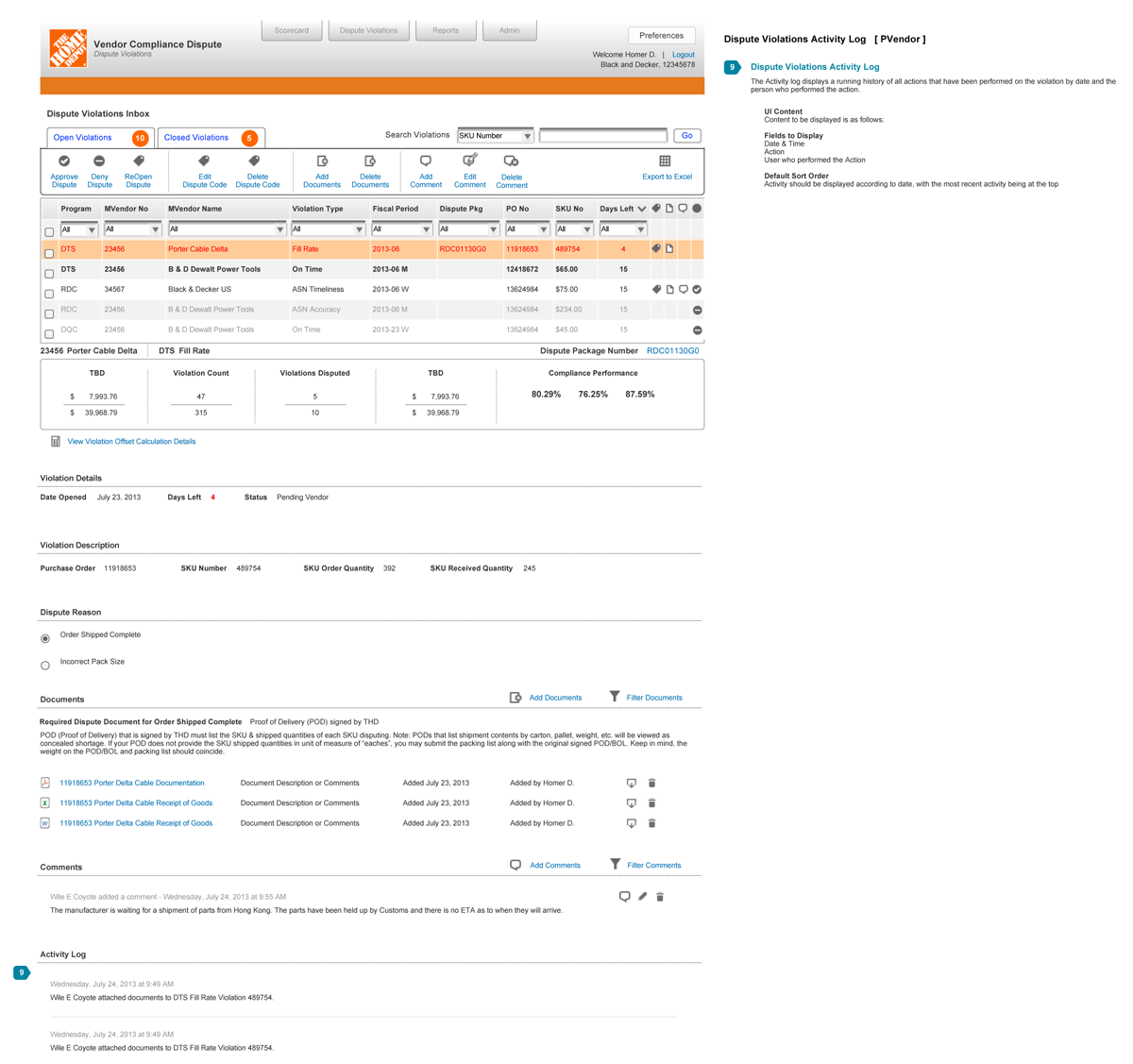
Every action timestamped: submission, status change, document upload, and AP team response captured in one place. Suppliers could track resolution without a phone call or email.
Supporting workflow states
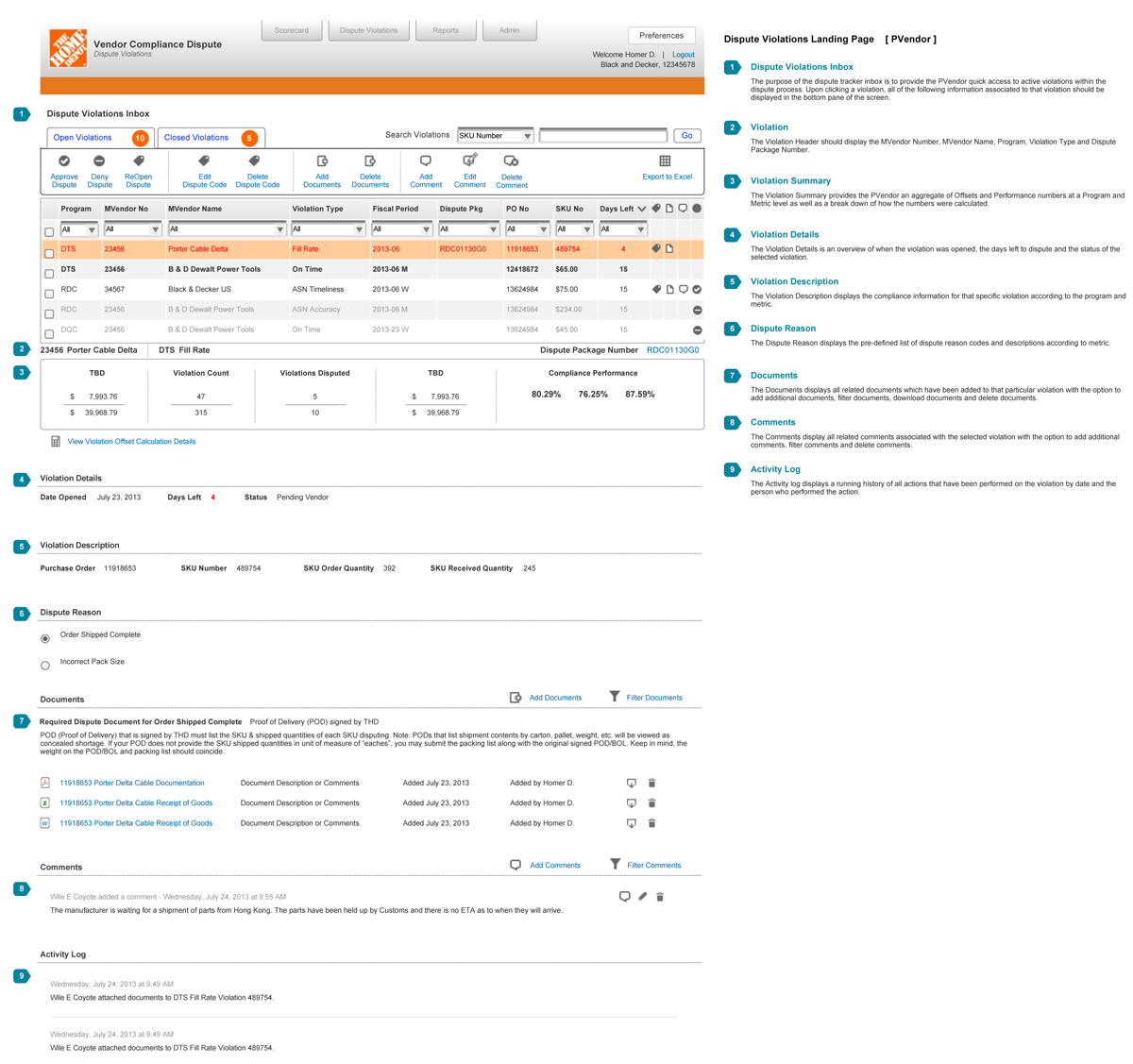
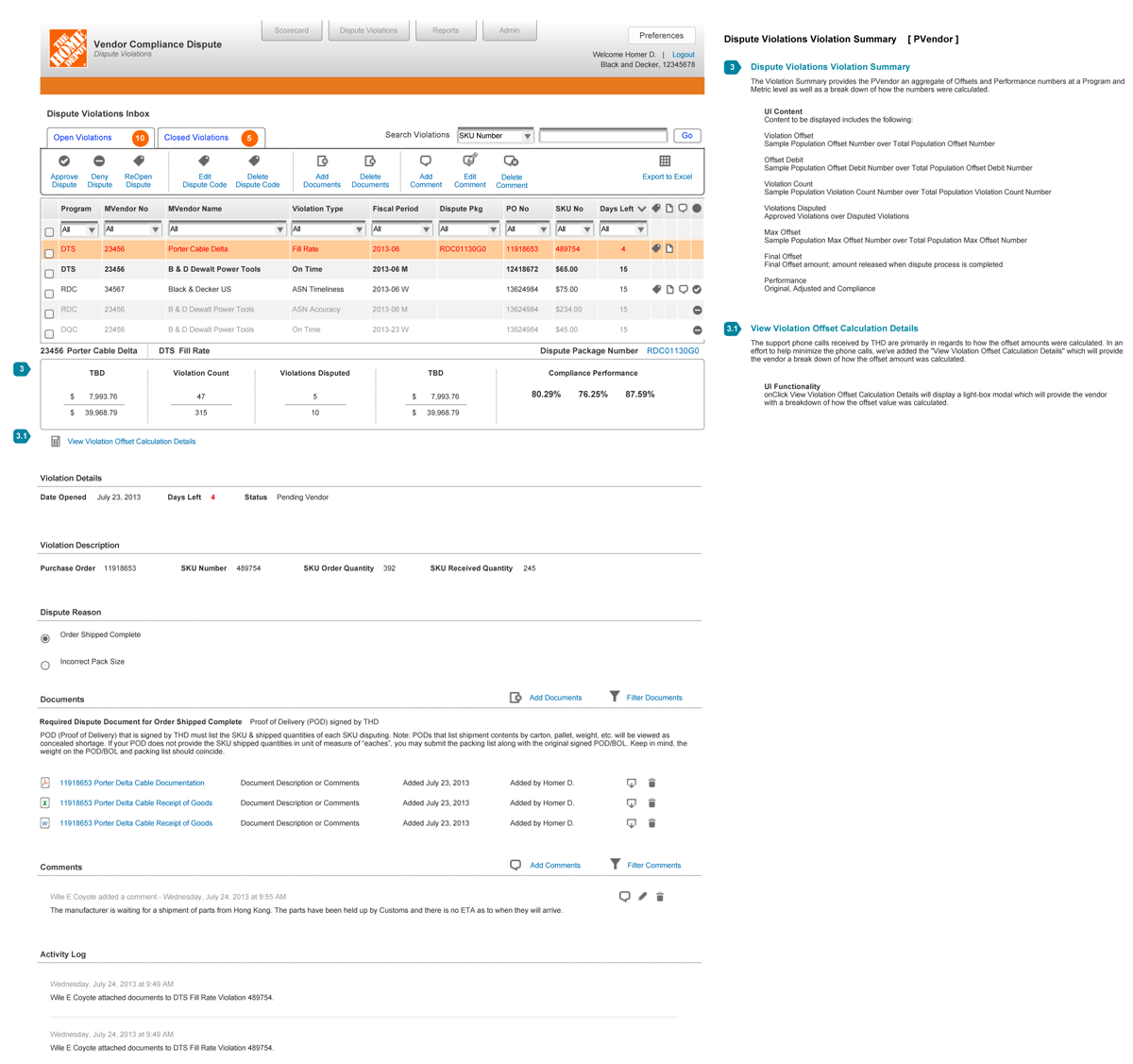
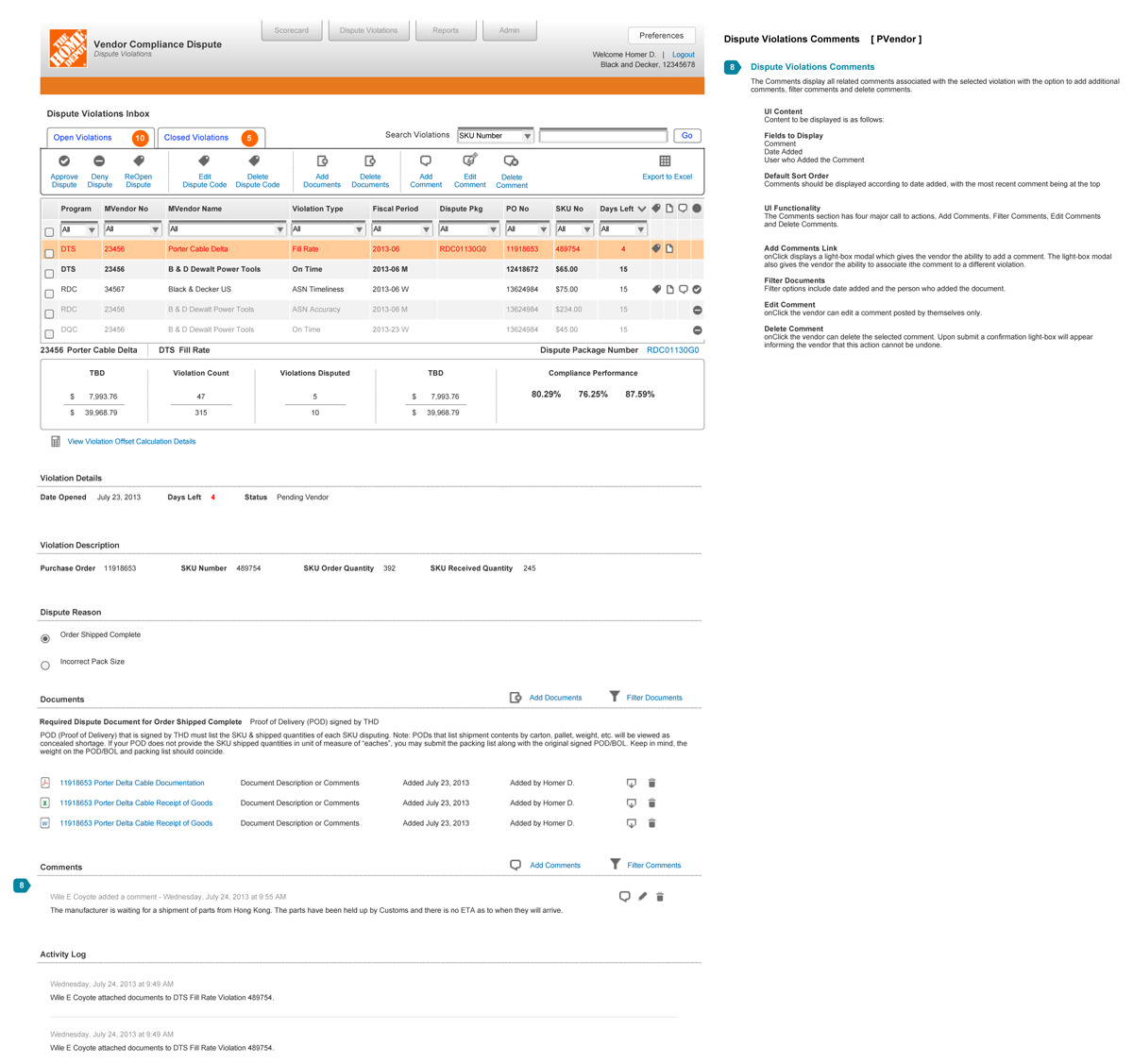
The workflow gave suppliers a clearer way to act and gave reviewers a more complete record. That reduced ambiguity for both sides and helped the process move forward with fewer missing pieces.
Designed to make review requirements visible before submission.
I designed the workflow to surface review requirements at the point of action. Suppliers were guided toward the correct reason, document type, and comment structure before submitting. Each submission created a traceable record tied to evidence, giving both sides a shared case history from submission through resolution.
Make a rule-based process easier to complete correctly — so suppliers could focus on building a strong case, not on interpreting the requirements.
Surfacing requirements early helped suppliers submit more complete packages and gave Home Depot a cleaner path to review. The workflow supported financial recovery on the supplier side and operational consistency on the reviewer side.
The most important design decision was sequencing.
When money, deadlines, and documentation are involved, users need to know exactly what decision they are making and what evidence supports it. A good enterprise workflow does not just collect information — it helps users understand what is required, in what order, and what happens after they submit.
This project reinforced a pattern I still use in complex operational products: design around the decision sequence. When each step is clear, documented, and tied to the review criteria, the product reduces ambiguity for users and creates better outcomes for the business.
How I turned complex legal, privacy, and account requirements into a reusable registration framework across Cartoon Network properties.
What This Shaped
The workflow gave suppliers and Home Depot reviewers a shared model: the same evidence requirements, the same deadlines, the same dispute reasons, and a complete audit trail from submission through resolution. At Home Depot's supplier scale, improving submission completeness across even a fraction of disputes represents meaningful financial recovery for the vendor base and reduced manual review work for the AP team.